
Resident Evil Requiem – Resident Evil Is An Action Series
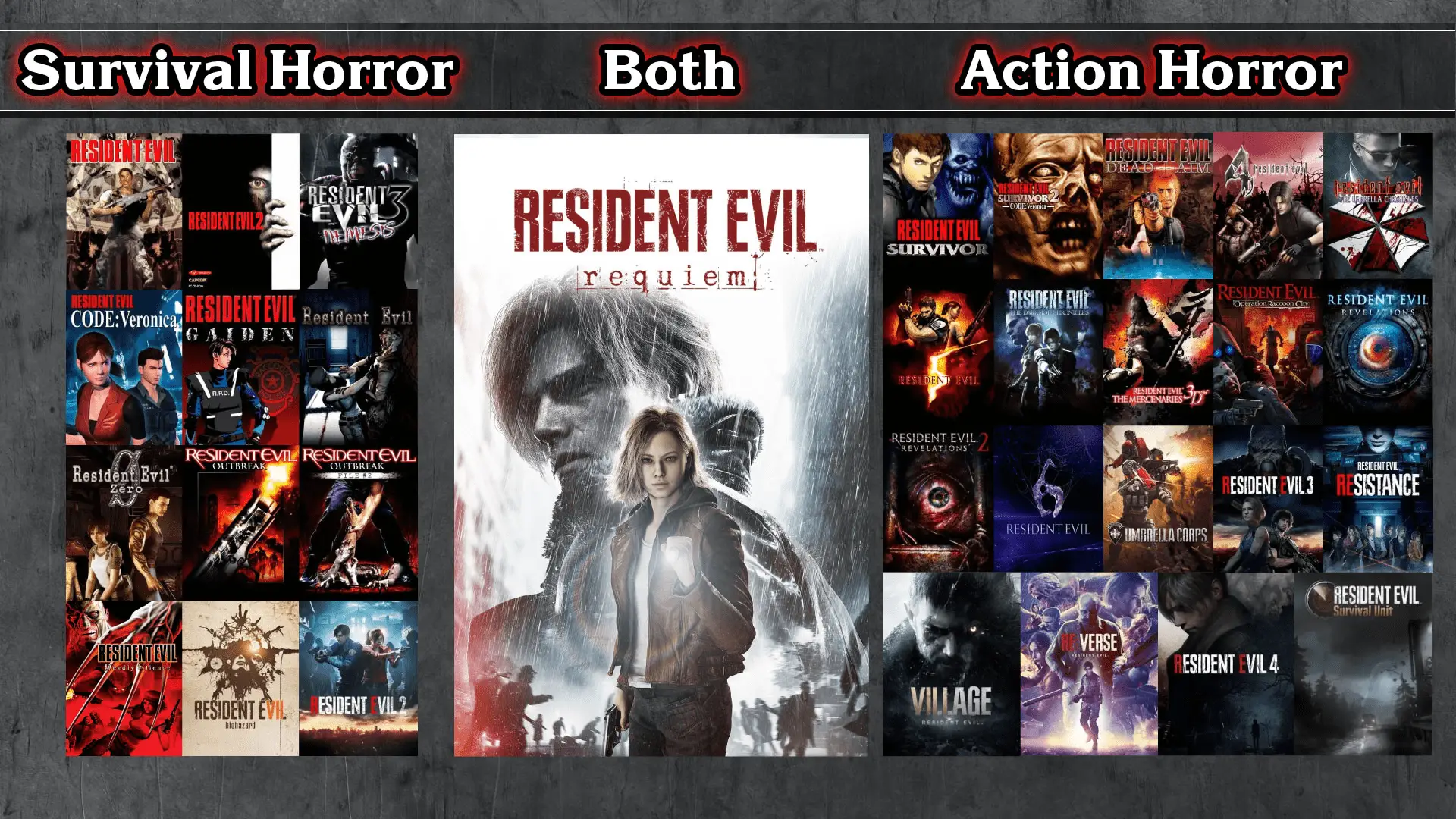
Resident Evil is a majority action series, and it is time survival horror fans acknowledged it. For years the franchise has been remembered as one of the defining survival horror series. Capcom even coined the term “survival horror” when marketing the original Resident Evil, a game that helped popularise the genre and inspire countless others. Earlier titles such as Alone in the Dark clearly influenced its design, but Resident Evil brought the formula to a far wider audience and cemented the genre in the public consciousness. Because of that legacy it is easy to assume that Resident Evil has always been primarily a survival horror series. The reality is more complicated. Over the years Capcom has steadily produced more action oriented entries in the franchise, to the point where survival horror titles are arguably now the minority. This shift is often blamed on Resident Evil 4, the hugely influential entry that pushed the series toward gameplay where combat is the primary tool for progression. In reality the move toward action began much earlier. If you’d rather see Resident Evil Requiem in action, watch the video version of this review below! Even on the original PlayStation, Capcom was already experimenting with more action focused ideas, Resident Evil 3: Nemesis leaned more heavily into combat and set pieces than its predecessors. The same generation also produced Resident Evil Survivor, a first person shooter spin off that moved the series even further toward action. The desire to push Resident Evil in that direction has been present since the early days of the franchise. This history leaves Capcom in an unusual position today. The series now has two large audiences with very different expectations. Some players remember Resident Evil as one of the best survival horror franchises ever made, while others know it primarily through its action heavy entries. With Resident Evil Requiem taking a completely unique approach, Capcom are attempting to appeal to both survival horror and action horror fans. They want to have their cake and eat it, which famously is not possible, but in this review I want to discuss that attempt. Would You Like To Combine These Items? Much like herbs can be combined, Capcom are attempting to combine genres with Resident Evil Requiem. It is the first game in the series that can truly be called a hybrid approach. The game functions as both survival horror and action horror, depending on whether you are playing as Grace or Leon. I once argued that Resident Evil 4 Remake was a “genre fluid” game, but I have since walked that back. Although there are some survival horror elements, it uses action and combat as the primary tools for progression, it ultimately falls outside survival horror and into action horror. Grace’s gameplay has three distinct phases. It begins with a slow, almost walking simulator style introduction. This is followed by stalker horror, before finally transitioning into more traditional survival horror. There is another return to stalker horror after Rhodes Hill hospital, and even during the hospital section there are stalker enemies that add a great deal of tension. For the most part though, it is fair to say that playing as Grace delivers a classic survival horror experience. The Rhodes Hill section is practically perfect survival horror. It is the best thing Capcom have produced since Resident Evil 2 Remake, which is exactly the direction I had hoped the series would return to, so I could not be happier about that. If I had to be critical, I would say the puzzles are quite light for a survival horror game, but the dynamic enemy interactions more than make up for it. The zombies felt individual, and Rhodes Hill felt like a real place. Its décor was as iconic as the Spencer Mansion or the Raccoon City Police Department. I was not sure if we would ever get locations like that again, but Rhodes Hill proves that it can still be done when Capcom want to. I love how the zombies migrate from room to room depending on where you are in the story and which zombies are still alive. it feels so organic and adds a lot of replay value. There are also moments where it is not even a question of having enough bullets. With Grace, it is often simply impractical to take zombies on directly. Instead, I found myself grabbing key items and getting out as quickly as possible, which is when the game is at its most tense. I was also happy with the early Leon sections in Rhodes Hill. They are short and effective, and a welcome break from the stalker segments where you cannot fight back. This is also where the combat feels at its best. In fact, I think the combat peaks here. I replayed this ten minute section several times and it felt different every time because of the unpredictable nature of the chainsaw enemy. The next time we see Leon is during a boss fight. Boss fights have always been part of Resident Evil and therefore part of the survival horror formula, so it felt completely natural to face the boss as Leon. After this, Leon retraces Grace’s footsteps through Rhodes Hill, where the only significant “zapping” section in the game takes place. This is another highlight for Leon. It is a system that deserves to be used far more often. After Rhodes Hill it almost feels as though the developers forgot about one of the game’s best features. It is also after this point that the real problems with Leon’s section begin to appear. I Wanted Raccoon City. But Not Like This. Who would have thought the apocalypse would be so depressing? I was genuinely excited when I heard we would return to Raccoon City. It has always been my favourite location in the series. Of course I knew there would not be much left of it after the thermobaric missile, but I did not expect Capcom to make it feel quite