
Carnival Massacre – Review
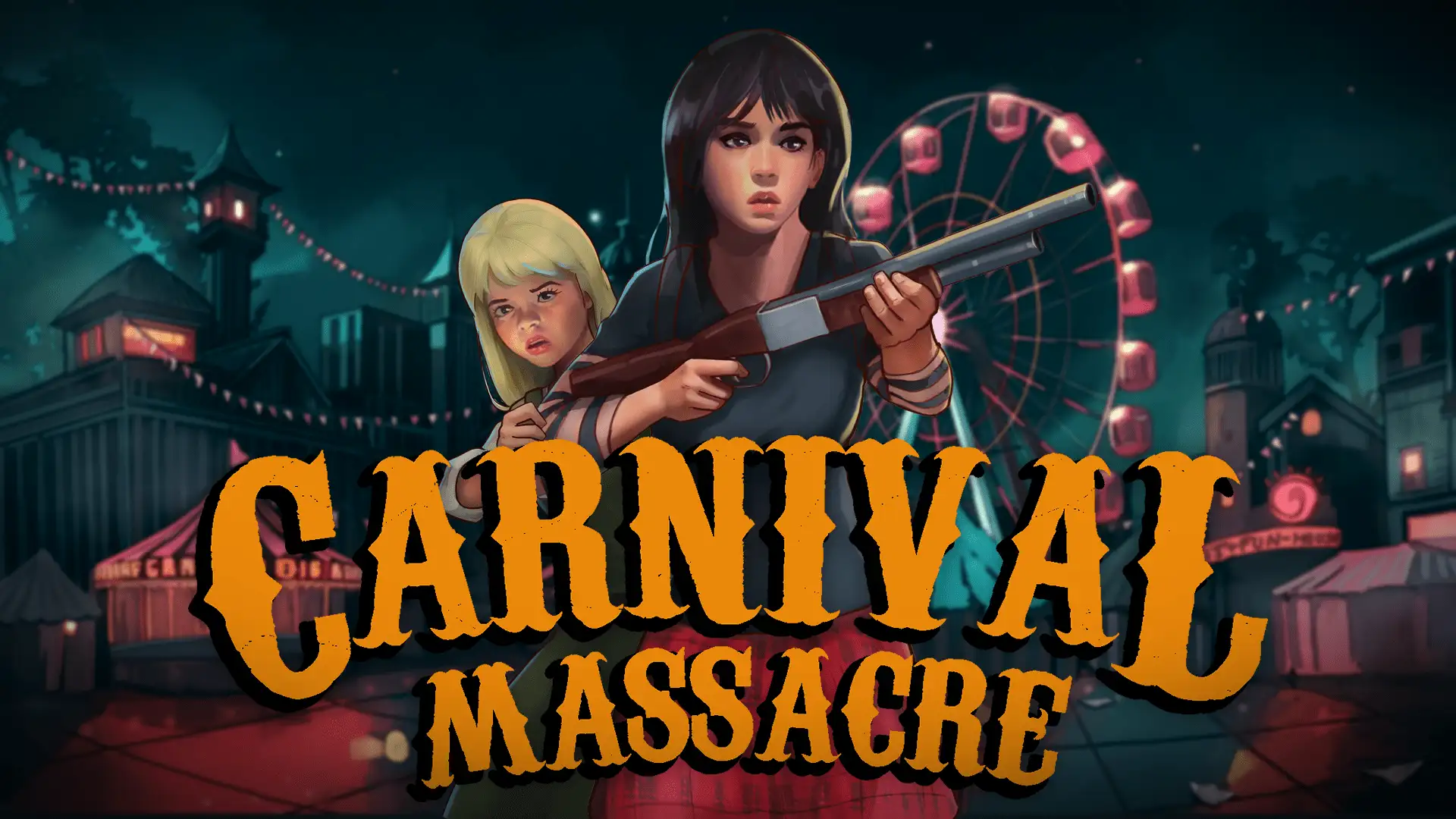
Carnival Massacre is a short but well made survival horror game inspired by titles such as Silent Hill, Alisa, and Heartworm. You play as Harley, who is searching for her missing sister Chloe in an abandoned carnival. It may not be the best game of 2025, but I enjoyed it enough that I wanted to cover it, especially as I worry it might be overlooked by survival horror fans. There have also been some unfounded plagiarism claims, which I address below. I also think Carnival Massacre could be an excellent introduction to the survival horror genre. I often see people ask, “I’m new to survival horror, what game should I start with?” Until now, I have struggled to give a clear answer. Heartworm is a good option, but it differs slightly from classic Resident Evil and Silent Hill because your primary tool is a camera rather than a traditional weapon. If you’d rather see Carnival Massacre in action, watch the video version of this review below! Carnival Massacre also features a camera, but here it is used to stun enemies. This is honestly one of the best avoidance mechanics I have seen in a survival horror game. It feels quite ingenious. There are also a few traditional weapons to use, including a shotgun, handgun, sniper rifle, and flamethrower Combat is not particularly difficult and can often be avoided altogether. There is a stalker enemy that cannot be killed, which adds some tension, but even this enemy is not too hard to evade. The puzzles are reasonably straightforward. You still need to think about them, but they are never so frustrating that they would put a new player off. Overall, there is nothing here that players should find overwhelmingly difficult. If someone does get completely stuck, survival horror may simply not be the genre for them. Before I talk more about the gameplay, I also want to address the plagiarism claims that have been made about the game. Alisa Controversy One of the main and most serious claims about Carnival Massacre is that it supposedly stole assets from Alisa. To be clear, there is no evidence that this happened. Casper Croes himself confirmed this in his Discord group, stating: “Just finished Carnival Massacre, definitely no assets stolen.” He added that “only ideas were somewhat taken over,” referring in particular to the way enemies in Carnival Massacre drop coins which can then be spent on resources or used to save the game. In Alisa, enemies drop tooth wheels which serve a similar purpose. Casper also pointed out that you could argue Resident Evil 4 did this first, with enemies dropping gold. I would also note that the save system is reminiscent of the ink ribbons in the early Resident Evil games. Another claim is that the menus in Carnival Massacre were copied from Alisa. When you place them side by side, the similarities are minimal. The main overlap is in the Alisa shop menu, where red curtains are used. However, red curtains are a common visual motif, and it is not as though Alisa owns the copyright to that idea. If we followed the logic that Carnival Massacre “stole” its red curtains from Alisa, we could just as easily say that Alisa “stole” the framed item displays and font style from Alone in the Dark, which would clearly be unreasonable. Many games share similar menu designs, simply because they draw from the same visual traditions. A related but less serious claim is that Carnival Massacre has been heavily influenced by Alisa. This is true to an extent, but influence is not the same thing as plagiarism. There are countless examples of indie games being openly inspired by earlier titles. In this case, it is simply an indie developer influenced by another indie developer, rather than by a major studio. It is also worth looking at the technical side of the asset theft accusation. Alisa uses pre-rendered backgrounds, which means the 3D assets are not stored in the game files in the same way they would be in a fully 3D game. What you see in-game is an image of the 3D model, rather than the model itself, so these assets cannot simply be ripped out and reused. While 3D character models do exist within the game files, even Casper has said that Carnival Massacre did not copy Alisa. All creative works are influenced by something. Alisa itself was inspired by Alice (1988), the surreal revision of Alice in Wonderland by Jan Švankmajer. Carnival Massacre would not be the game it is today without Alisa, but Alisa would not be what it is without Resident Evil, and Resident Evil owes a great deal to Alone in the Dark (1992). Survival horror continues to evolve because each new game builds on what came before. Demo VS Final Game When I first played the demo of Carnival Massacre my main concern was it would be way too easy to be a true survival horror, ammo was everywhere so there was no real need or reason to avoid the enemes. I was glad to see in the full game the ammo was easily halfed compared to the demo and instead of the ammo the player was given a camera that was probably inspired by Heartworm as mentioned earlier. In the demo, the route to the carnival takes you through a tunnel and then along a long road, where you spend around two minutes walking with very little to see or do. This slows the opening considerably. In the final game, the tunnel is blocked off and you instead follow a path through the forest. This more scenic route is clearly inspired by Heartworm and is a welcome improvement over the demo. It better explains how Harley gains access to the now closed carnival and significantly improves the overall pacing. Another feature I really appreciated was the in-game notepad. I often find it frustrating when a survival horror game expects you to search for a pen